HISTAGRA is organising the Agrobiodiversity Summer School 2026 at CISPAC
Agrobiodiversity Summer School, a training programme on the sustainability of food systems
CISPAC is spearheading this initiative on agrobiodiversity, involving staff from the Histagra research group
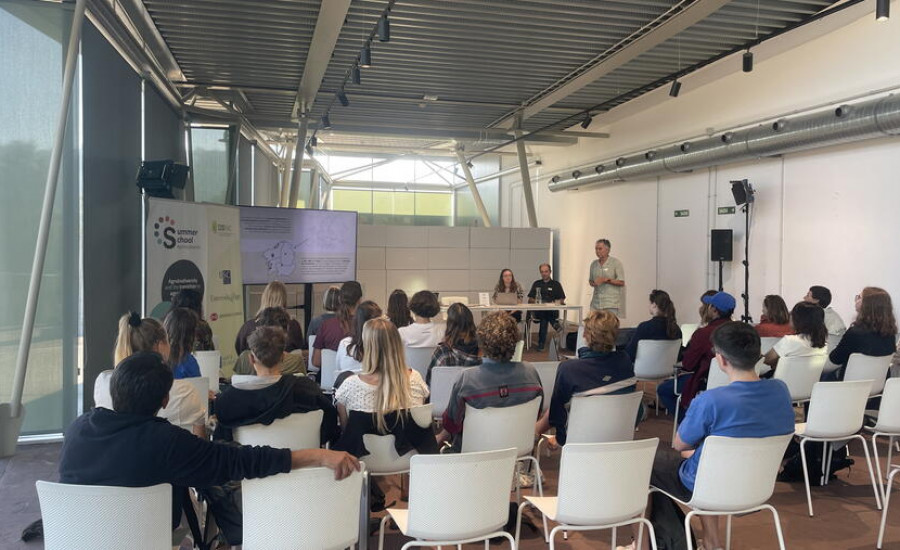
A new edition of the Agrobiodiversity Summer School is now underway in Santiago de Compostela. This international training course focuses on agrobiodiversity and the sustainability of food systems, with nearly 30 participants from eight countries. The initiative is organised by the Inter-University Research Centre for Atlantic Cultural Landscapes (CISPAC), of which the USC is a member, in collaboration with the Geography of Food research group at the Zurich University of Applied Sciences (ZHAW) and the Research Institute of Organic Agriculture (FiBL), and is funded by the Stiftung Mercator Schweiz.
This is the first time that this accredited training programme has been held at the same venue, as CISPAC was also a co-organising institution and host for the edition that took place in 2022. Lourenzo Fernández Prieto, David Soto Fernández and Stefania Barca, members of the Histagra research group at the USC and CISPAC, form part of the organising team and the school’s teaching staff, alongside researchers from ZHAW, FiBL, the University of A Coruña and Pablo de Olavide University.
The students, mainly Master’s students from a wide range of academic backgrounds — including environmental and human sciences, agronomy, food systems, rural studies and sustainability studies, amongst others — have spent the last few months undertaking a preparatory phase ahead of the face-to-face training that is now beginning. Until 13 September, participants will attend a series of training sessions and carry out fieldwork with local stakeholders in various parts of Galicia, adopting an applied, collaborative and place-based approach to learning. Taking an interdisciplinary perspective, the summer school aims to foster international exchange and stimulate discussion and critical thinking regarding the social and environmental challenges posed by landscapes, the territory, and systems of production and consumption.
The programme combines classroom sessions and group work with a series of visits to notable initiatives: the Entrelampo community garden and social inclusion project (Santiago de Compostela), the multifunctional model at Granjas de Lousada (Irixoa), the family-run wine-producing business Tierra de Asorei (Meis), the shellfish-gathering group in Muros, the Baroña forest community (O Porto do Son) and the Casa Bértolo dairy farm (Friol). These initiatives cover a range of aspects in terms of production and the environment, but also in social terms, as they comprise small family-run farms, cooperative projects and even mon
The diversity of agroecosystems and the wealth of historical knowledge that helps to explain it, as well as the social and environmental issues that threaten that diversity, are some of the areas of research that occupy a central place on CISPAC’s scientific agenda. These aspects, together with the unique interactions between humans and nature that characterise the region, make Galicia a highly suitable laboratory for training in agrobiodiversity and for exploring new pathways to sustainability on a global scale.