Work led by HISTAGRA highlighted in 2025 in the field of archaeology
HISTAGRA-led projects highlighted in 2025 in the field of archaeology
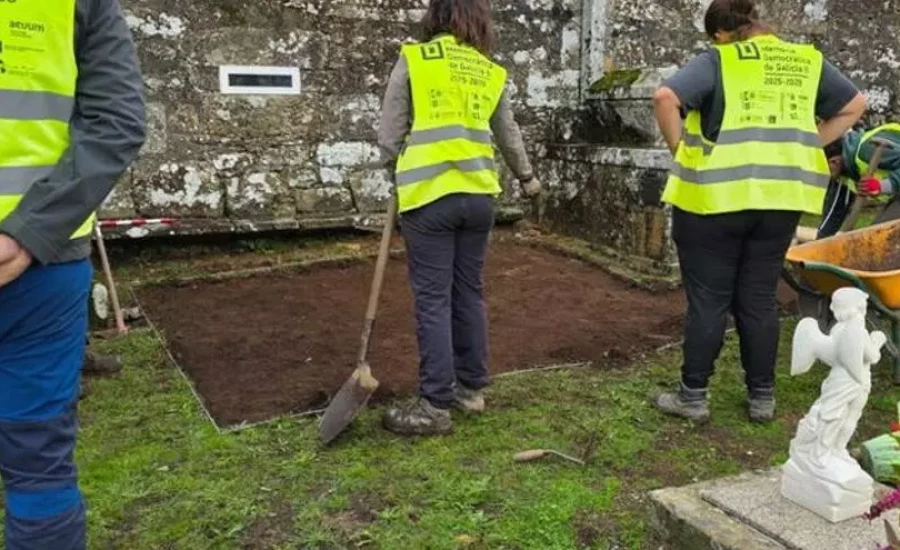
Every year, the Archaeological Park of the Castreña Culture in San Cibrao de Las compiles a ranking of archaeological projects that considers the ten top discoveries of 2025. This list includes the exhumation of the mass grave of Francoist violence in Luou, a project that is part of the Galicia 2025 Democratic Memory Plan and is led by HISTAGRA.
The grave, which was exhumed in November 2025, allegedly contained the remains of Manuel Agrasar ‘Barbarroxa’, Florentino Menéndez “Tino”, Vicente López ‘Rufino’ and Ricardo Fernández Carles, members of the anti-Franco resistance who were murdered in 1948.
In 2024, the team coordinating the actions of the Democratic Memory Plan received a formal request from the Oliveira de Teo Association to intervene in a grave linked to the anti-Franco resistance located in the atrium of the parish church of Luou. This entity has been working since at least 2009 on the recovery of historical memory and the defence of the municipality's intangible heritage. The grave is known locally as the Foucellas grave, a popular name that refers to Benigno Andrade García (‘El Foucellas’) and his group, and even to the guerrilla fighters of Galicia as a whole.
It was recalled that the burial had taken place at the end of May 1948, when four guerrilla fighters were killed during—and some even say after—a confrontation with the Civil Guard in the village of Loureiro, in the same parish. These guerrilla fighters were part of the group led by Benigno Andrade García, who managed to escape the altercation along with José Ramuiñán Barreiro, known as ‘Ricardito’. Their comrades were not so fortunate. The victims were Ricardo Fernández Carlés, from Pontecesures; Manuel Agrasar Cajaraville, from La Matanza (Padrón); Vicente López Nuevo, from Santa Uxía de Ribeira; and a fourth victim. Regarding the latter, both bibliographical references and institutional documents from the Franco regime offered various names—Constantino, Florentino, or Tino, as well as El Asturiano and the surnames Menéndez Palacio or in reverse order—so his identity remained unclear before the current investigation.
Members of the PMD in Galicia participated in the work, a team led by Lourenzo Fernández Prieto, Professor of Contemporary History at the USC, and coordinated by Antonio Miguez Macho, Professor of History at the same university. They were joined by archaeologist José Carlos Sánchez Pardo from the USC, forensic anthropologist Fernando Serrulla Rech from IMELGA, and the team from the Luis Concheiro Institute at the USC, led by Professor of Legal and Forensic Medicine Maria Victoria Lareu Hidobro. Alongside this team, the work of Lucia Santiago Sanmiguel in historical research and Tempos archaeologists in excavation tasks is noteworthy.
More information:
https://www.nomesevoces.net/gl/lugares/cartografia/fosas/90/fosa-del-cementerio-de-santa-maria-de-luou